
AI and the Future of Blue-Collar Workers: From Labour to Empowerment
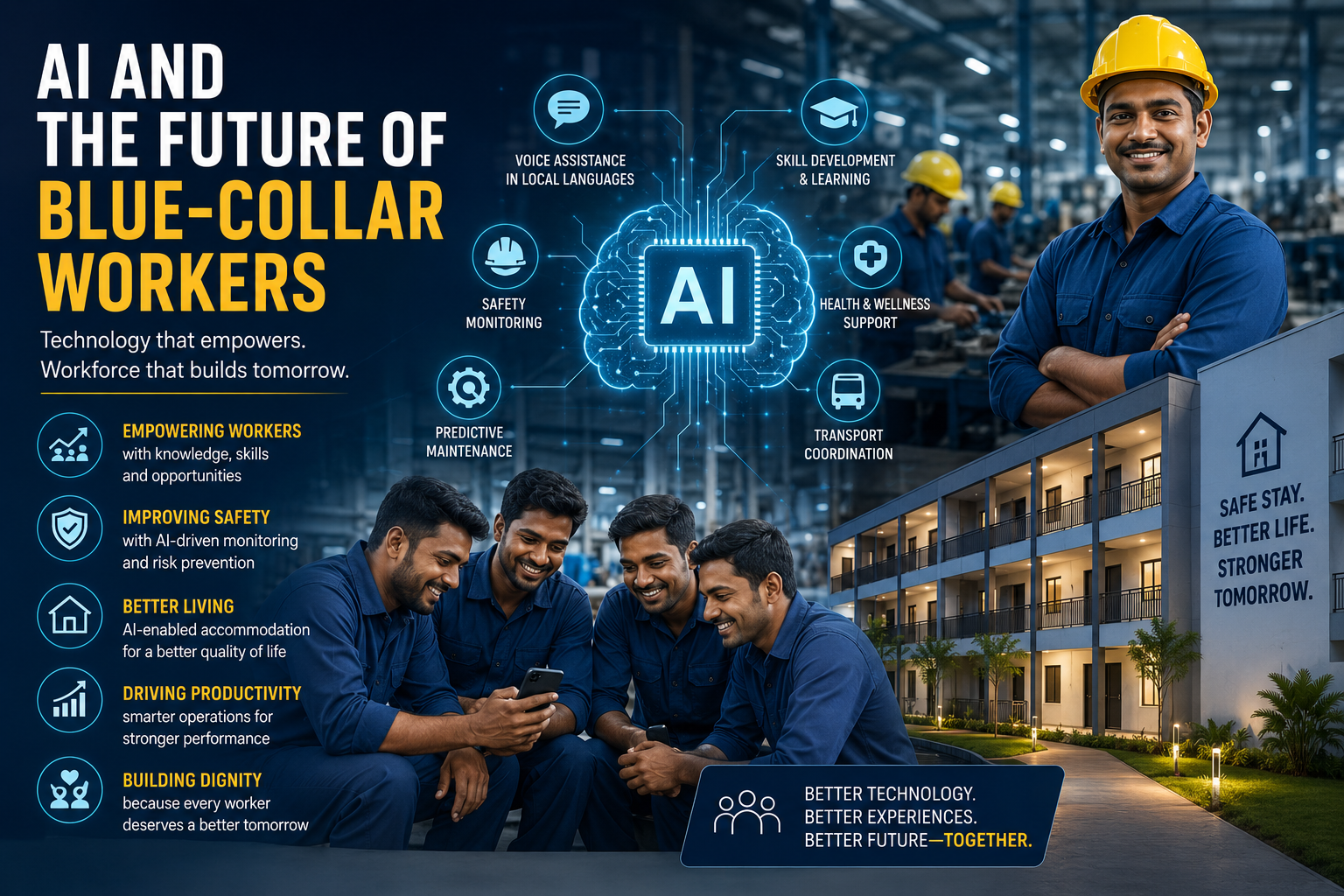
For years, conversations around Artificial Intelligence have focused heavily on white-collar jobs — software engineers, analysts, marketers, designers, and office productivity.
But one of the biggest transformations AI may create over the next decade could actually happen in the blue-collar workforce.
From manufacturing and logistics to construction, facility management, warehousing, retail operations, and worker accommodation — AI has the potential to fundamentally improve how blue-collar workers live, work, learn, and grow.
The question is no longer: "Will AI impact blue-collar industries?" It already is.
The real question is: Will AI empower workers, or simply replace parts of the workforce?
The Invisible Workforce Behind India's Growth
India's economic engine runs on millions of blue-collar workers. They build our infrastructure, run factories, move goods across the country, maintain cities, and power warehouses and supply chains.
Yet despite their importance, large sections of the workforce still face:
- Poor living conditions
- Lack of career progression
- Limited financial literacy
- Health and safety challenges
- High migration stress
- Low access to technology
This is where AI can become transformational — not just for companies, but for workers themselves.
AI Beyond Automation
When people hear AI, they often think about automation and job loss. But in blue-collar ecosystems, AI's biggest opportunity may actually be increasing human capability.
AI can help workers:
- Learn faster
- Communicate better
- Access services more easily
- Improve safety
- Reduce stress
- Build financial awareness
- Improve quality of life
In many cases, AI may become the first "digital support system" blue-collar workers have ever experienced.
AI in Worker Accommodation
Accommodation is one of the most overlooked parts of workforce productivity. For migrant workers, housing impacts physical health, sleep quality, retention, mental well-being, attendance, productivity, and worker dignity.
This is where AI can create meaningful change. Imagine worker accommodations that use AI for:
- Predictive maintenance
- Smart energy optimization
- Complaint management
- Voice-based support in local languages
- Safety monitoring
- Health risk detection
- Food and nutrition optimization
- Transportation coordination
Instead of accommodation being treated as just "beds and buildings," AI can help transform it into a worker experience platform.
For companies, this means:
- Lower attrition
- Better workforce stability
- Improved hiring outcomes
- Stronger compliance
- Better productivity
For workers, it means:
- Better quality of life
- Faster issue resolution
- More dignity and comfort
That shift matters.
Language AI Could Be a Game Changer
One of the biggest barriers for blue-collar workers is language and digital access. Many workers may not be comfortable reading English, using complex apps, or navigating digital systems.
AI-powered voice interfaces can change this dramatically. Workers could:
- Raise complaints by speaking
- Access salary details verbally
- Learn safety procedures in native languages
- Receive health guidance
- Get onboarding support
- Access government schemes
- Learn new skills
AI can effectively become a multilingual assistant for millions of workers who were previously excluded from digital ecosystems.
AI for Safety and Well-Being
In worker housing environments, AI can also identify:
- Overcrowding risks
- Hygiene issues
- Maintenance failures
- Water or electricity problems
- Security concerns
This moves companies from reactive management to proactive worker care.
The Human Side of AI
The future of AI in blue-collar industries should not be about replacing humans with machines. It should be about removing friction from workers' lives.
The companies that succeed in the next decade may not necessarily be the ones with the most automation. They may be the ones that best combine:
- Technology
- Human dignity
- Worker well-being
- Operational efficiency
That combination creates stronger businesses and stronger societies.
The Next Competitive Advantage
For years, companies competed using wages alone. Tomorrow, they may compete using:
- Better worker experience
- Better accommodation
- Better health support
- Better digital empowerment
- Better AI-enabled workforce systems
In that future, AI will not just be a software layer. It will become part of how companies attract, retain, and support their workforce.
And in countries like India, where millions of blue-collar workers drive industrial growth, that transformation could be enormous.
The future of blue-collar work may not simply be automated. It may finally become more humane, intelligent, and worker-centric.
Improve your workforce outcomes with Tikaana.
Talk to us about structured worker accommodation that pays for itself.
Talk to usMore from the blog
Site Adjacent Factory Employee Accommodation: Building the Foundation for India's Workforce Future
SAFE accommodation — professionally managed worker housing near factories and industrial hubs — is becoming critical infrastructure for India's manufacturing future.
Accommodation as a Competitive Advantage in Hiring
Wages alone no longer win blue-collar talent. Accommodation is becoming a deciding factor in whether workers join — and stay.